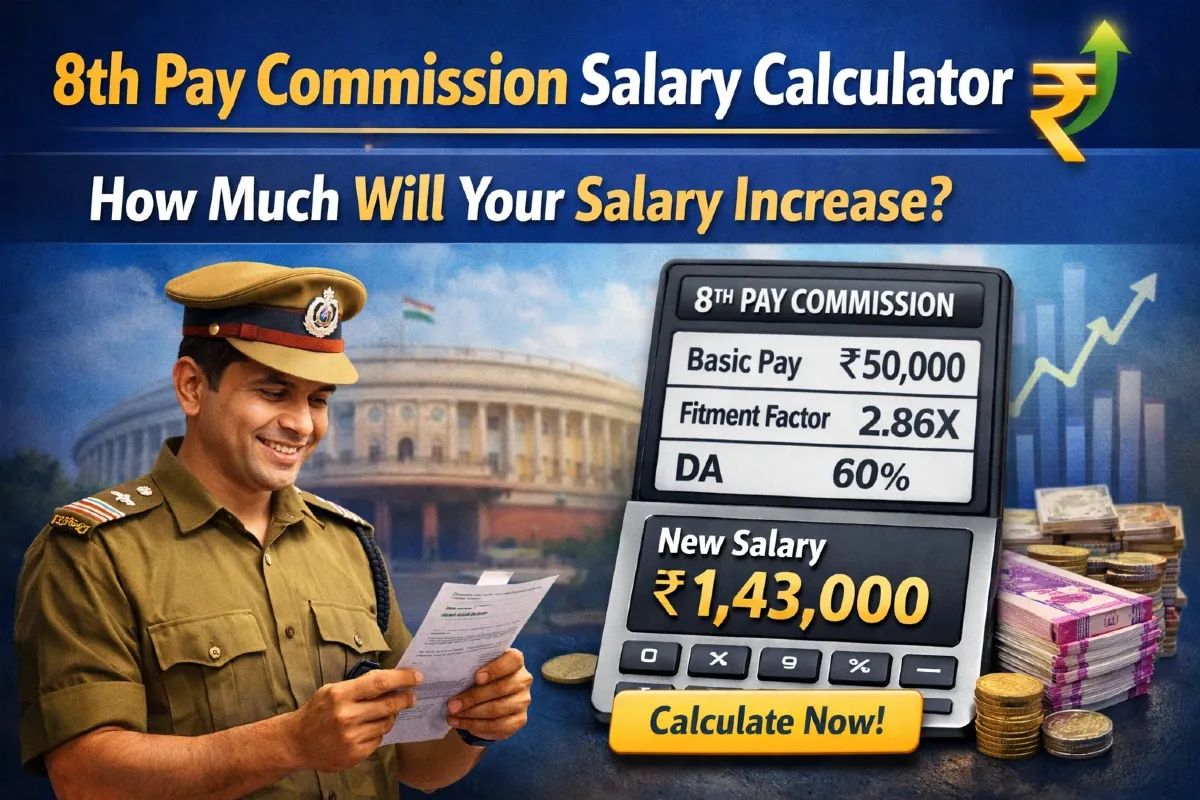
The discussion around the upcoming 8th Central Pay Commission has become one of the most searched topics among central government employees and pensioners in India. Millions of employees are eagerly waiting for official updates related to the expected salary hike, fitment factor, revised pay matrix, and pension benefits.
One of the biggest reasons behind this growing interest is the expected increase in the fitment factor, which directly affects the basic salary of government employees. Search trends show that keywords like “8th Pay Commission fitment factor”, “new salary structure”, “8th CPC latest news”, and “salary hike update” are getting massive traffic online.
If you want to estimate your revised salary instantly, you can check the free calculator available on TrueCalculation.
What Is the Fitment Factor?
The fitment factor is a multiplier used to revise the basic salary of central government employees whenever a new pay commission is implemented.
In simple words, the government multiplies the current basic salary by a decided fitment factor to calculate the new revised salary.
For example, under the 7th Central Pay Commission, the fitment factor was fixed at 2.57. This increased the minimum basic salary from ₹7,000 to ₹18,000.
Now employees are expecting a higher multiplier under the 8th Pay Commission.
Expected Fitment Factor Under 8th Pay Commission
Several employee unions and financial experts believe that the upcoming fitment factor may range between 3.00 and 3.68.
If this happens, the minimum basic pay of central government employees could rise significantly.
Expected Salary Projection
Current Basic Pay | Expected Fitment Factor | Estimated Revised Salary |
|---|---|---|
₹18,000 | 3.00 | ₹54,000 |
₹18,000 | 3.68 | ₹66,240 |
₹35,400 | 3.00 | ₹1,06,200 |
₹56,100 | 3.68 | ₹2,06,448 |
These figures are estimates based on expected calculations and public discussions. Final numbers will depend on official government approval.
This is why terms like “8th Pay Commission salary calculator” and “fitment factor calculation” are becoming highly searched keywords across India.
Why the Fitment Factor Is Important
The fitment factor is extremely important because it impacts:
Basic salary
Pension amount
Dearness Allowance (DA)
House Rent Allowance (HRA)
Gratuity
Retirement benefits
Monthly in-hand salary
Even a small increase in the fitment factor can create a major difference in the final salary structure.
For lakhs of employees working in railways, defense, postal departments, income tax offices, and administrative services, this revision can significantly improve financial stability.
Expected New Salary Structure Explained
The expected salary structure under the 8th Pay Commission may include multiple revisions apart from the fitment factor.
1. Higher Basic Pay
The minimum salary may increase from ₹18,000 to somewhere between ₹26,000 and ₹34,000 or even higher depending on the final fitment formula.
2. Revised DA Structure
Dearness Allowance is expected to play a major role in the next salary revision cycle.
Some employee organizations are demanding that DA should be merged into the basic salary before implementing the 8th CPC recommendations.
If this happens, employees could receive stronger long-term benefits.
3. Better HRA Benefits
House Rent Allowance may also increase depending on inflation and city classification.
Employees working in metro cities are expecting better HRA slabs due to rising housing costs.
4. Pension Revision
Pensioners are also likely to benefit from revised calculations linked to the new pay matrix and fitment factor.
This is why search traffic related to “8th Pay Commission pension increase” has increased sharply.
8th Pay Commission Pay Matrix Explained
The pay matrix system was introduced under the 7th Pay Commission to simplify salary calculations.
The upcoming pay commission may continue using a revised version of this matrix with updated salary levels and increments.
The pay matrix generally includes:
Pay levels
Annual increments
Basic pay progression
Promotion benefits
A revised matrix under the 8th CPC may improve salary growth opportunities for employees across different departments.
Why Employees Are Demanding a Higher Fitment Factor
There are several reasons behind the growing demand for a larger salary revision.
Rising Inflation
Inflation has increased significantly over the past few years. Employees argue that the current salary structure is no longer enough to manage rising expenses.
Increasing Cost of Living
Housing, education, transportation, and healthcare costs have increased rapidly in urban areas.
Government employees believe salaries should match modern economic conditions.
DA Growth
Dearness Allowance rates have continuously increased over the years. Many unions believe DA should now be merged into basic pay before the next commission.
Comparison With Private Sector Salaries
Employees working in technical and administrative roles often compare their salaries with private sector packages.
A stronger pay revision could help improve employee satisfaction and retention.
Will Pensioners Benefit From the 8th Pay Commission?
Yes, pensioners are expected to receive revised pension calculations if the new pay commission is implemented.
Historically, pension revisions are linked to:
Updated pay matrix
Revised fitment factor
DA adjustments
Retirement benefit calculations
This means retired employees may also receive a major financial boost after implementation.
Keywords such as “8th Pay Commission pension news” and “pension salary hike update” are already gaining strong search volume.
Possible Implementation Timeline
Currently, there is no official confirmation regarding the implementation date of the 8th Pay Commission.
However, experts believe discussions may accelerate closer to the expected salary revision cycle after the completion of the current pay commission period.
The process usually includes:
Formation of Pay Commission
Consultation with employee unions
Recommendation preparation
Cabinet approval
Official implementation
Because of this lengthy process, employees are closely tracking every news update related to the 8th CPC.
Economic Impact of the 8th Pay Commission
The implementation of a new pay commission can impact the entire economy, not just government employees.
Increased Consumer Spending
Higher salaries often increase spending in sectors like:
Housing
Electronics
Vehicles
Retail shopping
Travel
Economic Growth
Higher disposable income can improve market demand and boost economic activity.
Government Expenditure
At the same time, salary revisions also increase government expenditure significantly.
Balancing employee welfare and fiscal management becomes an important challenge for policymakers.
8th Pay Commission Latest News Trends
Search data clearly shows rising public interest in topics such as:
8th Pay Commission salary hike
Fitment factor latest update
Minimum salary increase
New pay matrix structure
Pension revision news
DA merger update
8th CPC calculator
This indicates that employees across India are actively searching for salary-related updates and future financial planning information.
How to Calculate Your Expected Salary
Employees can estimate their revised salary by multiplying their current basic pay with the expected fitment factor.
Example:
Current basic salary: ₹44,900
Expected fitment factor: 3.2
Estimated revised basic salary: ₹1,43,680
This estimated figure may further increase after adding allowances like HRA, TA, and DA.
You can quickly calculate your expected revised pay using the free online tool available at 8th Pay Commission Calculator.
Final Words
The upcoming 8th Pay Commission is expected to bring major salary revisions for central government employees and pensioners across India. The biggest focus remains on the fitment factor, which will directly determine the scale of salary increase.
Although official announcements are still awaited, discussions around revised pay structures, DA merger possibilities, and pension increases continue to dominate online searches.
Employees are now closely monitoring every update regarding the expected fitment factor, implementation timeline, and revised pay matrix.
To estimate your future salary based on expected fitment factors, visit TrueCalculation 8th Pay Commission Calculator.