Why is the 8th Pay Commission delayed and how will it impact salaries after 2026?
The 8th Pay Commission is one of the most awaited salary reforms for central government employees and pensioners in India. However, many people are asking why the commission appears delayed and what impact it will have on salaries once implemented after 2026. To understand this clearly, we need to look at government processes, economic conditions, and how previous pay commissions were handled.
Why does the 8th Pay Commission seem delayed?
First, it is important to understand that pay commissions are not automatic. The government sets them up after careful financial and administrative planning. While earlier pay commissions were generally implemented every 10 years, delays can happen due to several reasons.
One major reason is economic pressure. Inflation, fiscal deficit, government borrowing, and welfare spending all affect when a pay commission can be finalized. The government must ensure that salary hikes do not put excessive pressure on the national budget.
Another reason is the lengthy process involved. Once a pay commission is approved, it takes time to:
Form the commission
Collect data from departments
Analyze pay structures
Consult stakeholders
Prepare and submit the final report
This entire process usually takes 18 to 24 months.
Additionally, recent years have seen global economic instability, post-pandemic recovery costs, and increased government spending on infrastructure and social schemes. These factors contribute to delays in implementation even after the commission is announced.
So, the delay does not mean cancellation. It simply reflects cautious financial planning.
When is the 8th Pay Commission expected to be implemented?
Most experts believe the effective date will be January 1, 2026, similar to previous pay commissions. However, actual salary revisions may come later, with arrears paid retrospectively.
This means employees might receive:
Revised salary from the implementation date
Lump-sum arrears once approved
This has happened in earlier pay commissions as well.
Expected salary impact after 2026
The biggest question is how much salary will increase after the 8th Pay Commission.
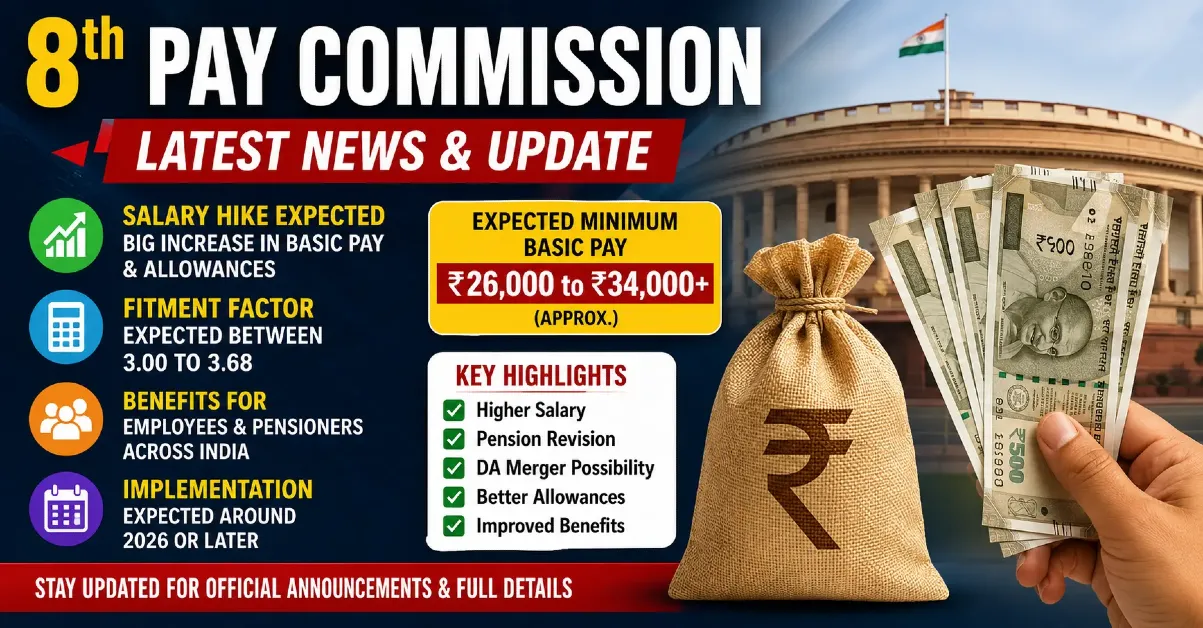
While no official numbers are available yet, estimates suggest:
25% to 34% overall salary hike
Increase mainly driven by a higher fitment factor
The fitment factor is the multiplier applied to existing basic pay to calculate the new basic salary. Under the 7th Pay Commission, it was 2.57. For the 8th Pay Commission, experts expect it to be between 2.8 and 3.2.
For example:
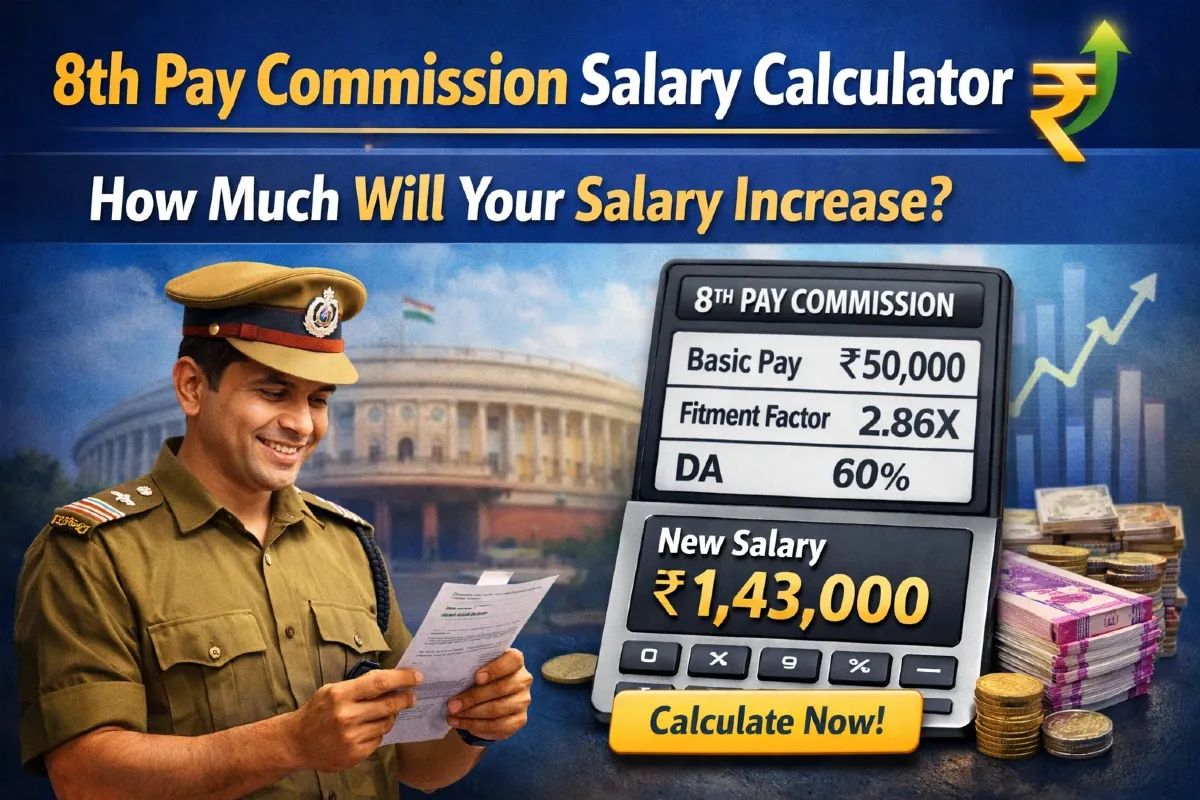
If someone’s current basic pay is ₹18,000
After revision, it could increase to ₹50,000 or more depending on the final fitment factor
This would significantly improve take-home salary.
What happens to Dearness Allowance (DA)?
A very important change expected is DA merger.
Before implementing a new pay commission:
DA is usually merged into basic pay
DA is then reset to zero
After that, DA starts increasing again based on inflation
By 2026, DA may cross 60%, making merger highly likely. This merger alone can cause a substantial jump in basic pay.
Impact on pensioners
The 8th Pay Commission will not only benefit serving employees but also pensioners.
Expected benefits include:
Higher minimum pension
Revised pension based on new pay matrix
Better family pension calculations
This is especially important for retired employees facing rising healthcare and living costs.
Who benefits the most?
Lower and mid-level employees (Level 1 to Level 7) are expected to benefit the most because:
Minimum pay is likely to increase significantly
Pay compression issues may be corrected
Allowance structure could be simplified
Senior officers will also benefit, but proportional gains are usually higher for lower levels.
How can employees prepare in advance?
Employees should:
Understand their current pay level and basic pay
Track DA percentage growth
Use reliable online tools to estimate revised salary
Websites like True Calculation help employees estimate possible salary changes under the 8th Pay Commission using expected fitment factors and DA merger assumptions. These tools give a realistic idea of future income and help in financial planning.
Final thoughts
The delay in the 8th Pay Commission is not a negative sign. It reflects the government’s careful approach to balancing employee welfare and economic stability. Once implemented, the commission is expected to bring a major salary reset, improved pensions, and better financial security for millions of government employees.
For employees, the key is patience and preparation. The 8th Pay Commission, whenever finalized, is likely to be one of the most impactful pay revisions in recent years.